A Rejection of Frictionless Cooking
For two decades, the trajectory of professional cooking in Australia pointed in one direction: more control, more consistency, more technology. Sous-vide machines, induction hobs, and combi ovens promised that a kitchen could produce identical results every service, regardless of who was on the grill. The return to wood fire is, in part, a rejection of that promise.
The Staff Canteen‘s 2025 analysis captured this shift precisely: chefs are “rebalancing away from heavy reliance” on low-temperature cooking and “leaning back into direct heat,” welcoming “a small degree of unpredictability” because it produces food that “feels alive, immediate and expressive”. This is not a Luddite retreat from technology—many of the same kitchens still use circulators for specific tasks. It is a recalibration of what matters in the final plate.
Fire as Cultural Inheritance
The most interesting wood-fired restaurants in Australia in 2026 are not the ones importing European technique. They are the ones using fire to articulate cultural identities that have been marginalised or simplified in the mainstream market. Agnii in Windsor is the obvious example: Gayan Pieris is not opening a Sri Lankan restaurant that happens to have a grill; he is opening a restaurant built around the specific hearths of Sri Lankan domestic cooking, complete with clay pots that accumulate “soul” over time.
The Age noted that Pieris wants to change perceptions of Sri Lankan food in Melbourne, moving beyond the “buffet” associations that have constrained the cuisine‘s reputation. Fire is the vehicle for that ambition. Similarly, at Hamsi Taverna inside the new Sydney Fish Market, chef Somer Sivrioglu is using charcoal grilling to translate the seafood culture of the Bosphorus and Aegean coast into a Sydney context, with whole fish cooked over open flame and a balik ekmek sandwich that Urban List describes as “rooted in Istanbul street food but dialled into Sydney‘s seafood culture”.
The Social Dimension
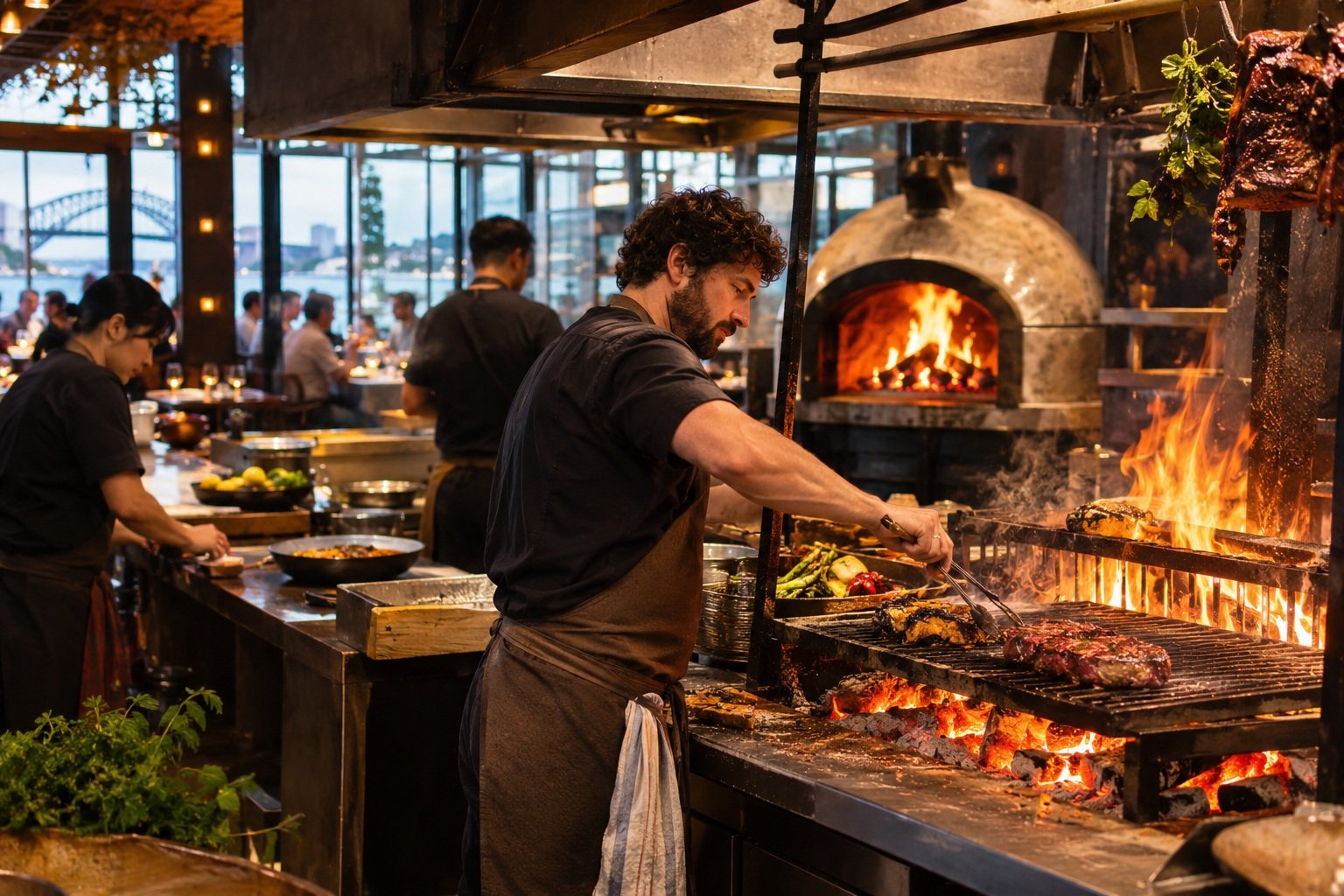
Wood fire is inherently social. It draws people toward it—the warmth, the sound of crackling embers, the smell of smoke in the air. In a dining landscape increasingly divided between delivery apps and high-end tasting menus, the wood-fired restaurant occupies a middle ground that feels both democratic and special. The Australian Good Food Guide‘s 2026 survey of fire-cooked venues repeatedly returned to this theme: Ates in Blackheath is described as “rustic, welcoming and full of character,” inviting guests to “gather around the table, pour a glass and savour seasonal flavours”. Rambutan in Townsville centres its rooftop around a pool and a wood-fired oven, creating a space designed for “social gatherings or sunset drinks”.
This is not incidental. The return to fire is also a return to a particular kind of eating—slower, shared, and rooted in place. In an industry obsessed with efficiency and scale, the wood-fired restaurant offers a counter-proposition: that some things are worth the wait, and that the best meals are the ones you can smell before you taste them.