A Landmark Moment for Australian Fashion
In March 2026, the Australian Fashion Council and R.M.Williams launched the National Manufacturing Strategy for Australian Fashion and Textiles 2026-2036 at Parliament House in Canberra. It was the first coordinated national roadmap to rebuild targeted domestic manufacturing capability across Australia’s textile, clothing, and footwear sector.
The strategy was not developed in isolation. It resulted from nearly a year of industry consultation, including 14 national consultations with manufacturers, brands, educators, and policymakers. More than 300 stakeholders contributed, generating over 1,000 proposed initiatives and nearly 900 votes on strategic priorities.
For fashion educators and students, the strategy represents far more than a policy document. It is a blueprint for what the industry will look like in 2036 — and, by extension, what fashion education must produce to support it.
The Workforce Challenge: A Sector at a Crossroads
The strategy confronts a stark reality. With 97 per cent of Australia’s clothing and textile products manufactured offshore, the sector is vulnerable to global supply disruptions and trade volatility. Rather than attempting to compete against high-volume offshore manufacturing markets, the strategy focuses on closing structural gaps and accelerating advanced manufacturing to scale Australia’s comparative advantage in premium, technology-enabled, and traceable production.
One of the most pressing challenges identified is the demographic profile of the manufacturing workforce. The median age of Australian textile manufacturers is 57, and 58 per cent of the workforce are women. Additionally, 41 per cent come from culturally and linguistically diverse communities. The strategy explicitly prioritises creating new skilled pathways for advanced manufacturing roles and enabling skills transfer to a younger generation.
What This Means for Fashion Schools
The implications for fashion education are profound. The strategy’s emphasis on advanced manufacturing, circular innovation, and fibre-to-fibre recycling requires graduates who understand production technologies that have not traditionally been part of fashion curricula.
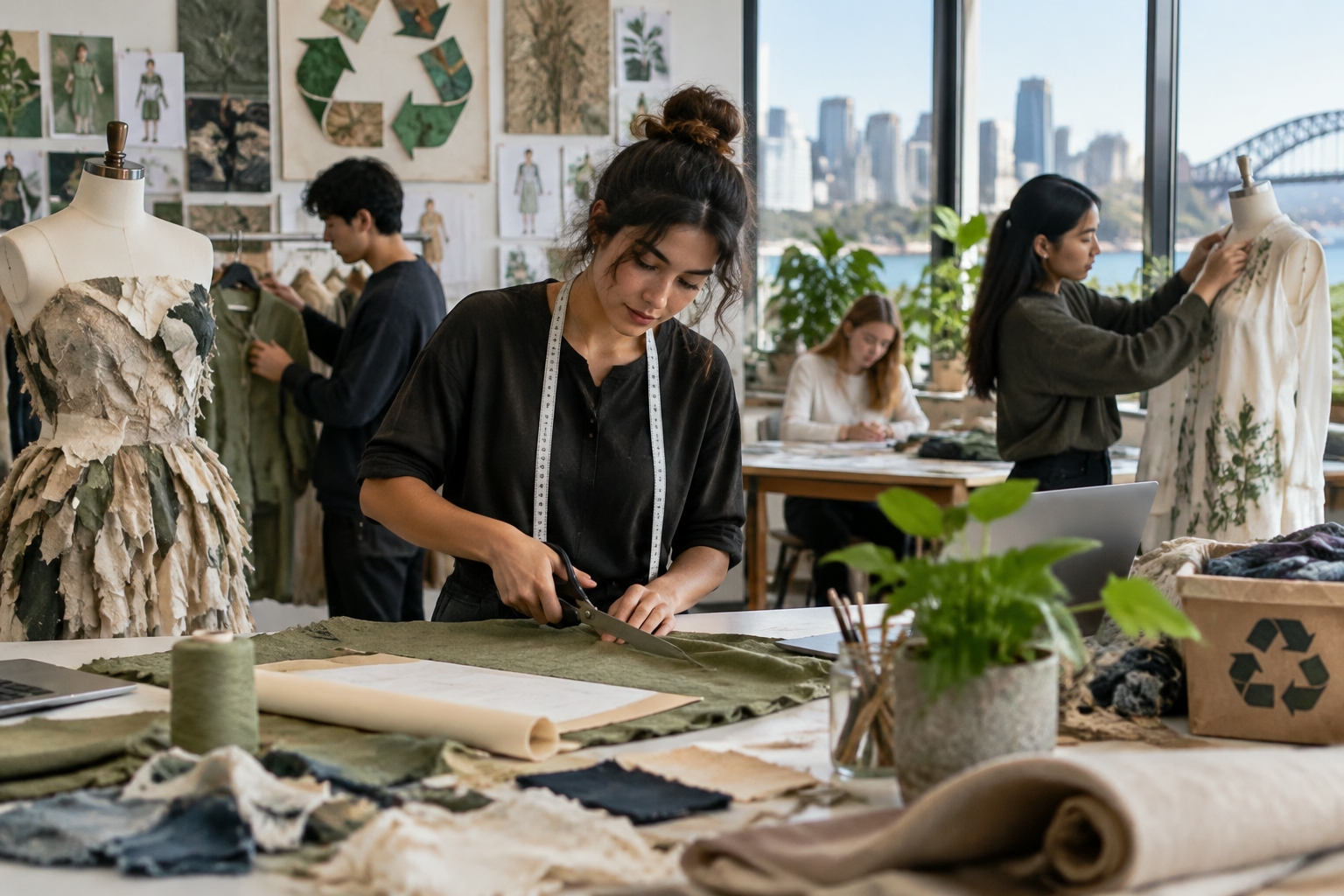
Australian fashion schools are already adapting. RMIT’s Associate Degree in Fashion includes a simulated industry workroom at its Brunswick campus, enabling face-to-face learning that replicates the conditions of modern manufacturing environments. The university’s Bachelor of Fashion Enterprise and Technology covers global fashion supply chains, advanced textile materials, and circular fashion design thinking — precisely the competencies the national strategy identifies as critical.
TAFE institutions are also responding. Certificate III and IV programs in Apparel, Fashion and Textiles now include training in computer-aided pattern design, digital textile printing, and automated garment construction — skills that directly support the strategy’s goal of accelerating advanced manufacturing.
The Economic Case for Education Investment
The strategy is underpinned by independent modelling from RMIT University and RPS, which projects that full implementation of its coordinated policy platform will grow textile, clothing, and footwear manufacturing value added from $2.6 billion to $2.9 billion by 2030-31.
This projected growth is contingent on a skilled workforce. Without graduates who understand advanced manufacturing technologies, circular design principles, and global supply chain management, the strategy’s ambitions cannot be realised. Fashion schools are not merely beneficiaries of the strategy — they are essential delivery partners.
Three Strategic Pillars, One Educational Imperative
The strategy is built on three pillars: activating and driving demand, securing the workforce of the future, and accelerating advanced manufacturing. Each pillar has direct implications for fashion education.
The demand pillar requires graduates who can build brands that resonate with consumers seeking transparency and quality. The workforce pillar demands that schools produce graduates with the technical skills for modern manufacturing roles. The advanced manufacturing pillar necessitates training in new machinery, emerging technologies, and circular production systems.
Australian fashion schools are uniquely positioned to deliver against all three pillars. They sit at the intersection of creative design, technical production, and commercial strategy — the precise nexus where the strategy’s ambitions will either succeed or fail.
A Decade of Opportunity
The National Manufacturing Strategy sets a ten-year horizon. For students entering fashion programs in 2026, this means that by the time they graduate, the industry they enter will be actively rebuilding its domestic production capacity. They will not be spectators to this transformation — they will be the professionals who design for it, manage it, and lead it.
The strategy’s success will be measured not only in economic output but in the careers it creates and the designers it empowers. Australian fashion schools have a central role to play in turning that vision into reality.