The Landmark Research That Reframes the Debate
Screen Currency 2026, described by Screen Australia as a landmark piece of research, provides the most comprehensive evidence base to date on the economic, cultural, and social value of Australian screen and games production. The report’s findings simultaneously validate the sector’s importance and expose its most pressing vulnerability.
On the economic front, the numbers are unambiguous. Australian screen and games contributed over $11 billion to the economy in FY 2023/24 and directly employed nearly 70,000 people in FY 2024/25. Exports totalled $1.6 billion in FY 2023/24, with the games sector experiencing average annual export growth of 15.4% between FY 2016/17 and FY 2023/24. These figures establish the sector as a significant contributor to national economic output, not merely a cultural artefact deserving of public subsidy.
The Consumption Paradox
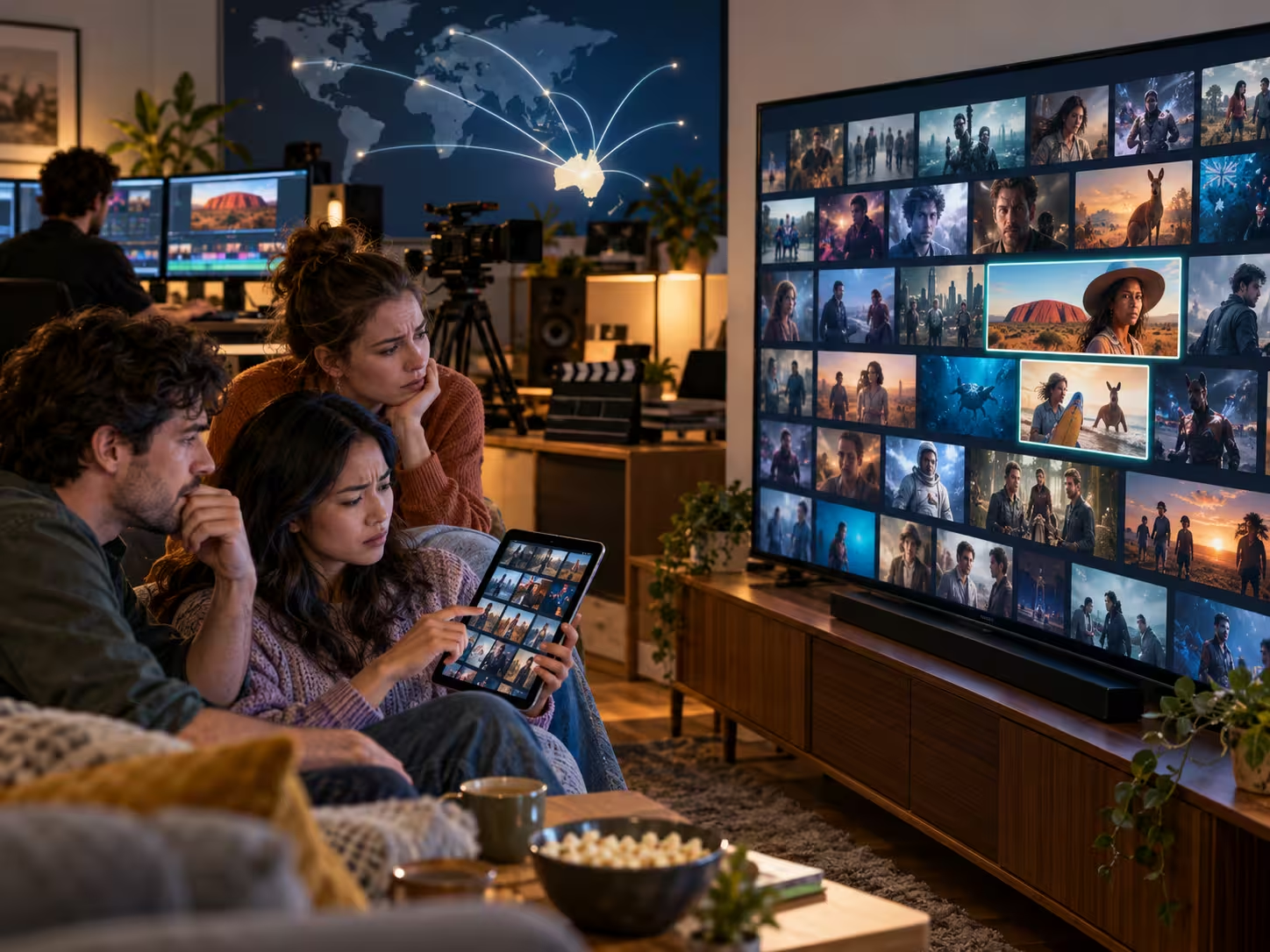
Yet the report also reveals a troubling disconnect between stated values and actual behaviour. While 84% of Australians agree access to local screen content is important and 75% express interest in watching more, nearly two-thirds of Australians spend less than 30% of their viewing time on it. The report attributes this gap partly to discoverability: only 36% of Australians say local content is easy to locate.
This paradox has profound implications for policy and industry strategy. It suggests that the problem facing Australian screen IP is not primarily one of production capacity or audience appetite, but of connection—the mechanisms and incentives through which content reaches viewers in an increasingly fragmented media environment.
Beyond Economics: The Social Value of Local Content
Screen Currency 2026 also documents the social and cultural impacts that flow from Australian content engagement. The research found that 71% of Australian audiences take some form of action after engaging with local content—they discuss it (43%), conduct further research on a topic (36%), recommend it to others (27%), or even change their behaviour (22%).
Minister for the Arts Tony Burke emphasised this dimension: “Australian content shapes our culture, discussions and our understanding of each other, and gives us that all-important sense of belonging”. The report specifically highlights the cultural and social value of First Nations content in reinforcing identity, community connection, and cultural continuity.
The Global Opportunity
Where the domestic picture is mixed, the international outlook is more encouraging. The Screen Currency 2026 Global Insights report documents that Australian content generates positive perceptions of the country across every market surveyed. In India, 67% of audiences say Australian screen content gives them a positive impression of Australia, while 68% of Indian and Chinese audiences say it makes them more interested in visiting.
The soft power effects extend to trade: 65% of Indian audiences report increased interest in Australian products and businesses after watching Australian content. These spillover effects suggest that investment in screen IP generates returns well beyond the sector itself.
The Strategic Implications
Screen Australia CEO Deirdre Brennan framed the report’s implications for industry strategy: “Australia has extraordinary talent and internationally recognised capabilities, but there is no doubt we are in a pivotal moment of transformation for the sector. Future success will require support for Australian businesses to build enduring intellectual property, strengthen audience relationships, improve discoverability and compete confidently in global markets”.
The report’s findings have already informed Screen Australia’s Market & Audience program redesign, which introduced Assets, Audience Testing, and Channel Management programmes in January 2026. These initiatives represent a recognition that production funding alone cannot solve the discoverability challenge.
Screen Currency 2026 ultimately delivers a dual message: Australian screen IP generates substantial economic and cultural value, but realising its full potential—domestically and globally—requires addressing the connection gap between production and audience. The $11 billion industry exists. The challenge is ensuring Australians and the world can find it.