A Legacy Written in Food
The story of Greek food in Australia is inseparable from the story of Greek migration. Almost half a million Australians claim Greek ancestry, making them one of the largest groups within the global Greek diaspora. Melbourne is said to have the third-largest Greek population of any city in the world, after Athens and Thessaloniki. This demographic reality has shaped the nation’s food landscape in profound ways, from the milk bars of the mid-twentieth century to the souvlaki shops that became late-night institutions.
In April 2026, a cultural evening in Marrickville, Sydney, titled “Anyone for Spanakopita?”, drew a strong crowd to celebrate this legacy. Organised by Inner West Council Libraries and the Greek Festival of Sydney, the event explored the influence of Greek cuisine on Australian food culture, with local historian Vasilis Vasilas weaving together Marrickville’s Greek history with the evolution of dishes such as spanakopita. More than 450 pieces of the traditional spinach pie were prepared and shared, a gesture that was as much about community as it was about cuisine.
The Evolution of a Dish, the Evolution of a People
Vasilas’s remarks at the event captured the essence of the Greek food revival. “Dina and I are not here to patent spanakopita,” he said, referring to the cooking demonstration led by local cook Dina Fakas. “We are not here to say Greeks made spanakopita first… because spanakopita across the Aegean Sea, in Turkey, is called ispanalk pide and in the Arab world it is called fatayer bi snakekh… tonight is about celebration of popular delicacy across Greece which is also shared across the Balkans and Mediterranean”.
This acknowledgment of shared culinary heritage is significant. It reflects a mature, confident Greek-Australian identity—one that does not need to claim ownership of a dish to celebrate it. Instead, it locates Greek food within a broader Mediterranean and Middle Eastern culinary continuum, recognising that the free exchange of ingredients and techniques has always been a defining feature of the region’s food culture. This openness is a hallmark of the contemporary revival, which is characterised by curiosity rather than defensiveness.
From Nostalgia to Innovation
The evolution of Greek-Australian food culture is also visible in the stories of individual entrepreneurs. In October 2026, The Age reported on the opening of a small shop in Sydney Road, Brunswick, whose prime product is bougatsa—a custard-filled pastry—by an owner who had migrated from Greece in 1968. This is the old story: migration, hard work, and the transplantation of a beloved tradition to a new land. But it sits alongside a new story: the rise of Greek-Australian businesses like Born To Bake Greek, which was named Australia’s Best Cake Shop and Patisserie in 2026, recognised for both traditional pastries and a modern approach to presentation and business.
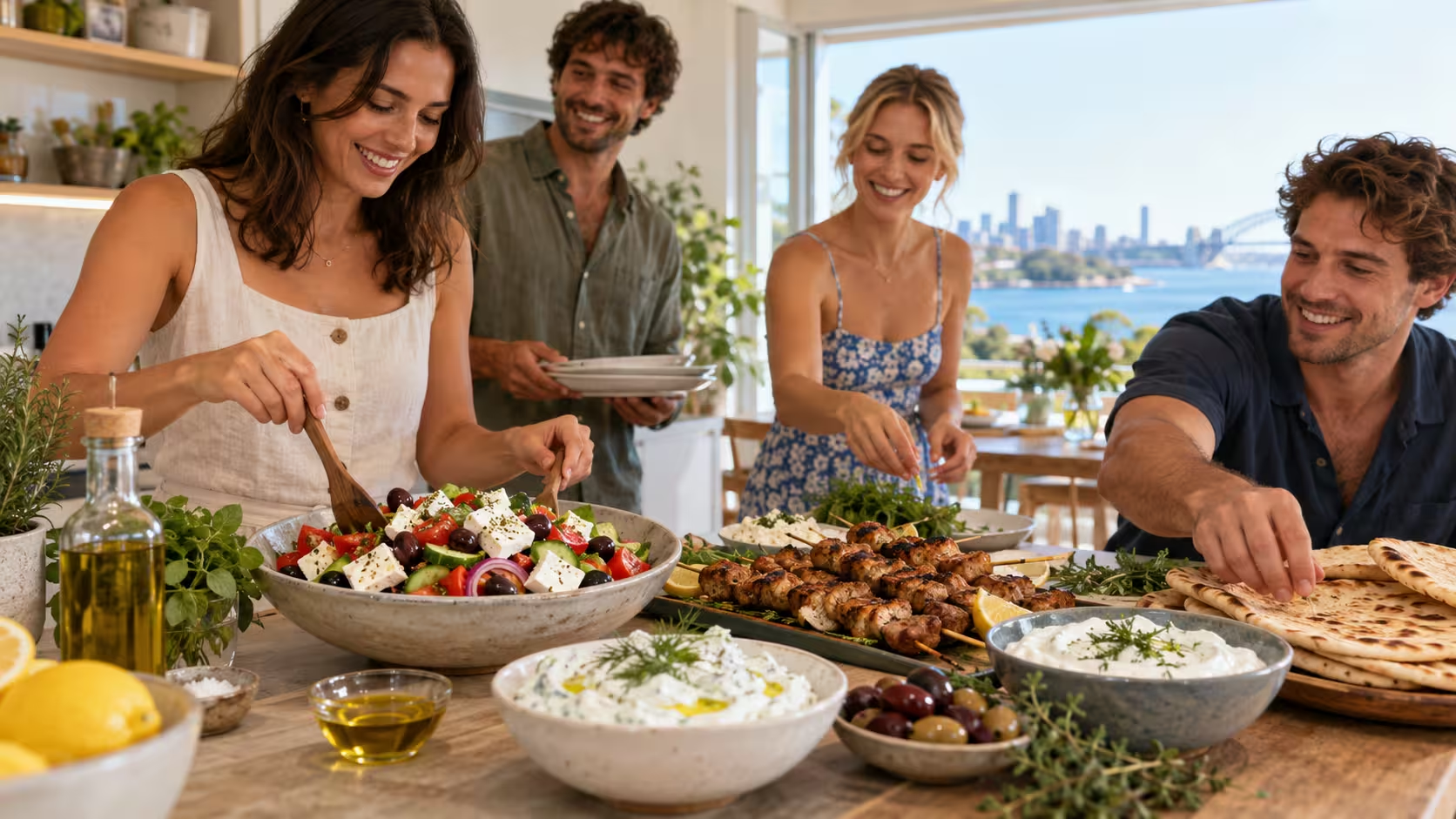
The revival is not about choosing between tradition and innovation; it is about recognising that they are inseparable. The Greek food now being celebrated in Australia—whether in a three-storey diner in Malvern, a beachside taverna in Adelaide, or a community hall in Marrickville—is the product of generations of adaptation and resilience. It is a cuisine that has survived and thrived because it has never been static. As the Consul General of Greece in Sydney, George Skemperis, noted at the Marrickville event, Greek cuisine has evolved through global influences, and it is this capacity for evolution that ensures its continued relevance.
The Greek food revival in Australia is, at its core, a story of identity. It is the story of a community that has moved from the margins to the mainstream, and of a cuisine that has moved from nostalgia to innovation. It is a story that is still being written, one shared plate at a time.