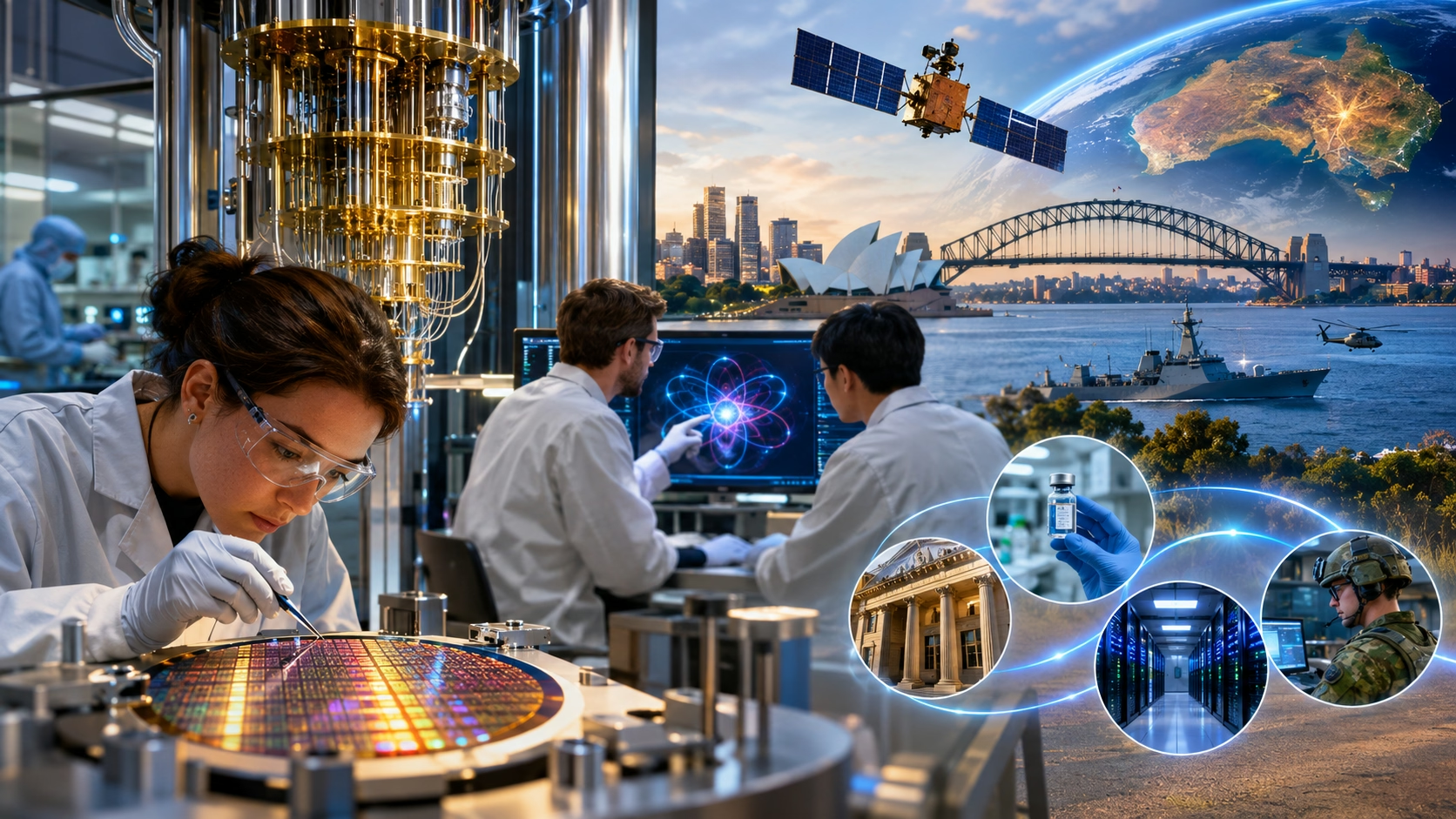
The most revealing signal about Australia’s critical technology trajectory does not come from a single funding round or government strategy. It comes from the composition of the country’s flagship deep tech cohort. In 2026, Tech23, run by Cicada Innovations, selected a group of startups in which sovereign capability was not a side theme but the organising principle.
A Cohort Defined by National Priority
A record number of startups applied for the 2026 Tech23 cohort. Five of the 23 selected companies are working directly to strengthen Australia’s sovereign capability, and another ten operate in advanced manufacturing, AI, semiconductor hardware, and defence to protect supply chains.
Cicada Innovations CEO Liza Noonan described the shift in explicit terms: “Australia’s deep tech founders are increasingly focusing on building for national priority areas, and many of these innovations have dual-use potential, strengthening our sovereign capabilities.” She added that the shift calls for strong strategic support from both industry and government to realise commercial potential.
The cohort’s range illustrates how broadly “dual-use” now applies. Stratoship, founded in Brisbane in 2020, launched Australia’s first high-altitude airship into the stratosphere; its COO is the world’s first female remote high-altitude pilot. ANT61 and MP Space are working on aerospace solutions. Gega Elements is refining gallium for semiconductor supply chains, while Cortisonic develops ultra-low-power edge processing. Forward Deployed, Dentroid, Armatide Pharmaceuticals, and Arelis are tackling critical resilience, healthcare, and defence technology.
Instrumentation as Strategic Enabler
The dual-use logic is perhaps clearest in companies that sell to commercial and defence customers simultaneously. Canberra-based Liquid Instruments designs software-defined instrumentation that replaces multiple pieces of traditional test equipment with a single reconfigurable platform. Its technology supports aerospace, defence, semiconductors, quantum research, and complex electronics, and is used by Nvidia, Lockheed Martin, Blue Origin, PsiQuantum, BYD, and Intel.
In 2026, Liquid Instruments secured $70 million in Series C funding**, with the NRFC investing **$28.45 million to consolidate and scale manufacturing in Australia. The sovereign rationale was explicit: keeping high-value engineering and advanced manufacturing onshore while creating highly skilled roles.
The company’s dual-use credentials are not theoretical. Liquid Instruments contributed to the ANU Quantum Optical Ground Station that supported NASA’s Artemis II optical communications demonstration, helping beam 4K video back to Earth in April 2026. The same instrumentation capability that serves commercial semiconductor testing also serves space communications and defence signal processing—a portfolio that would be difficult to sustain without a domestic manufacturing base.
The Commercial-Defence Flywheel
The mature dual-use model is not about repurposing defence technology for consumer markets, or vice versa. It is about building platform capabilities that are valuable across both, so that commercial revenue funds continued development while defence contracts provide scale and validation.
HEO illustrates the same flywheel from the space domain: its Non-Earth Imaging cameras and software serve allied defence and intelligence agencies, but also commercial satellite operators for repair and recovery monitoring. Space Machines Company builds responsive spacecraft for satellite protection—a defence-aligned mission—but frames its value proposition around cost-effective, scalable systems that change the economics of space security across commercial and public use.
The ecosystem-level effect is a broadening of the addressable market for Australian deep tech. A founder no longer has to choose between a small domestic commercial market and a distant defence procurement process. The dual-use framing allows a single platform to pursue both, provided the capital stack can tolerate the different sales cycles.
What the Ecosystem Still Needs
The 2026 cohort reveals a genuine maturation in ambition, but it also exposes remaining gaps. Deep tech commercialisation timelines routinely exceed standard venture fund lives. Manufacturing scale-up—whether for quantum chips, spacecraft, or instrumentation—requires patient capital and physical infrastructure that Australia is still building. And the translation from cohort visibility to contracted revenue remains a bottleneck that no amount of ecosystem convening can fully resolve.
What has changed is the framing. Deep tech in Australia is no longer discussed primarily as a research commercialisation problem. It is discussed as a national capability problem—and that reframing is attracting a different class of capital, a different class of founder, and a different level of policy attention.